Setting a price because "that is what the competitor charges" or "it has always been this way" leaves the menu's profit to chance. Menu engineering rests on two questions: how much of this dish do I sell, and how much does each sale leave me? In this article we first calculate recipe cost, then classify the menu on those two questions and tie the result to pricing decisions. All figures in the examples are hypothetical; use your own prices.
Step 1: Calculate the recipe cost
Recipe cost is the sum of the cost of every ingredient used in one portion sold:
Portion cost = Σ (ingredient quantity × ingredient unit cost)
Points to watch in the calculation:
- Use a single unit. Enter an ingredient always in kilograms or always in grams; mixed units are the first source of errors.
- Allow for yield loss. Vegetables lose weight when trimmed and meat when cooked. Write the gross quantity you buy into the recipe, not the net quantity you see on the plate.
- Do not forget the small items. If listing oil, spices, sauce, packaging and napkins one by one is hard, add a fixed allowance per portion.
- Keep unit cost current. For ingredients whose price moves often, the weighted average cost gives a steadier picture than the last purchase price. Take the purchase cost excluding VAT, not including it, and confirm with your accountant which VAT is recoverable.
- Make preparations their own recipes. Sauces, dough and marinades prepared in batches are easier to cost with their own recipe, which also simplifies the main one.
A hypothetical calculation for a hamburger:
| Ingredient | Quantity | Unit cost | Amount |
|---|---|---|---|
| Beef mince | 0.150 kg | 400 per kg | 60.00 |
| Bun | 1 piece | 6 | 6.00 |
| Lettuce, tomato, onion | 1 portion | 5 | 5.00 |
| Sauce | 30 g | 0.10 per g | 3.00 |
| Packaging and service allowance | 1 | 4 | 4.00 |
| Total | 78.00 |
In adisyus, recipes are defined in the Production section; the recipe screen shows the total cost for one unit sold and tells you when the total is incomplete because an ingredient has no cost or a mismatched unit.
Step 2: Strip out VAT and find the cost percentage
The price on the menu includes VAT. The cost percentage is calculated against the price excluding VAT:
- Price excluding VAT = Menu price ÷ (1 + VAT rate)
- Cost percentage = Portion cost ÷ Price excluding VAT × 100
- Contribution margin = Price excluding VAT − Portion cost
If the hamburger's price excluding VAT is 200, the cost percentage is roughly 39 per cent and the contribution margin is 122. Apply the VAT rate in force. There is no single right cost percentage for everyone; the target differs between a coffee bar and a steakhouse. What matters is to see the percentage dish by dish and set a deliberate target.
Step 3: Classify the menu on two axes
For every dish work out two values: popularity (its share of the units sold in its category) and contribution margin (per dish, in currency). Use the average of your own category as the threshold. Four boxes emerge:
| Class | Sales | Contribution margin | What to do |
|---|---|---|---|
| Star | High | High | Protect it: keep it visible, hold the quality, do not raise the price sharply |
| Workhorse | High | Low | Raise the price in small steps, review ingredients and portion, suggest a high-margin add-on |
| Puzzle | Low | High | Increase visibility: feature it, have waiters recommend it, improve its name and description |
| Dog | Low | Low | Remove it, or redesign the recipe and price |
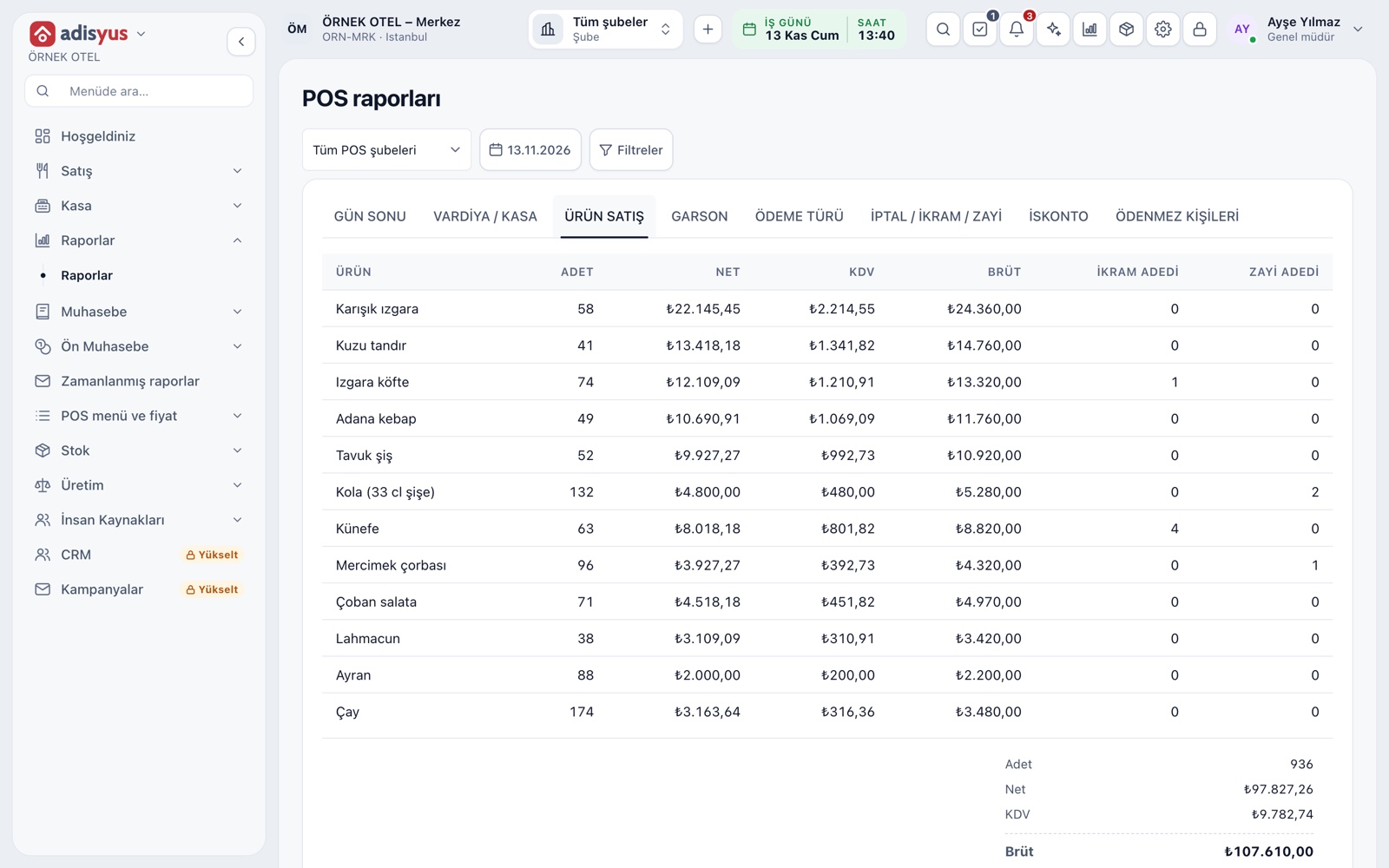
You take the data from two places: the product sales report gives units, net sales, comped quantity and wasted quantity per product, and the recipe screen gives the portion cost. You can combine the two in a spreadsheet to build the matrix. Do count comps and waste: if 100 portions were sold and 6 more were comped or wasted, ingredients were used for 106 portions.
Step 4: Change prices in a controlled way
- Move in small steps. Small, regular adjustments per dish cause less guest reaction than one large increase.
- Set price by channel. You can define separate price lists for dine-in, delivery and online, and a list can apply on certain days and hours. Lunch-menu pricing is managed this way. Read your contracts with outside platforms first to see whether they carry a price condition.
- Measure the effect. Watch units and product mix for two weeks after a change; if the drop in units wipes out the margin gain, go back.
- Refresh the recipe when supplier prices move. As goods receipts are confirmed, the last purchase price on the stock card is updated; review the recipe cost after such changes.
- Calculate the margin of combo menus separately. Compare the price of a combo with the total cost of its components, not with the sum of their menu prices.
Common mistakes
- Calculating the cost percentage on a price that includes VAT.
- Leaving packaging, garnish and yield loss out of the recipe.
- Deciding with outdated costs.
- Looking at a single dish and forgetting the product mix, the menu as a whole.
- Not seeing that puzzles and dogs take up space on the menu.
A three-week routine
- Week one: Work out the recipe cost of your ten best sellers.
- Week two: Build the matrix and place every dish in one of the four classes.
- Week three: Choose a single action per class, apply it and watch the result for two weeks.
Conclusion
Menu engineering lets you judge dishes not as "good" or "bad" but on sales and margin together. A reliable recipe cost is the foundation of this analysis; if the foundation is incomplete, so is the decision. For recipe and stock costing details in adisyus, see Stock and Recipe Costing.